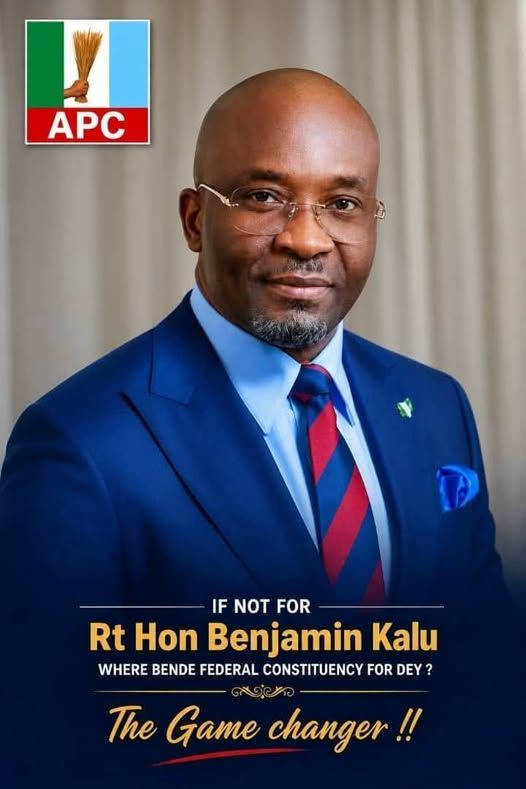
Headlines:
Bende Is Bigger Than One Hall: Representation Must Be Measured Beyond a Single Project
By: Aglow TV
If the new yardstick for determining who deserves to enter the Green Chambers is now the construction of a particular hall, then Benjamin Kalu must have done plenty enough to keep some people awake!. One would even expect some modern-day blind Bartimaeuses to start asking where the hall is located. But honestly, the desperation behind such arguments is becoming quite obvious. When the substance of a campaign argument is weak, almost anything can suddenly become a political ladder.
Today, it is a hall; tomorrow, it may be a borehole, classroom block, or another single project. The attempt is to create the impression that the entire performance of a federal legislator should be judged by whether one particular community has received one specific facility. But that is not a fair or intelligent way to assess representation. Benjamin Kalu represents the entire Bende Federal Constituency, not one ward, village, or community. Different communities have different challenges, and responsible representation requires identifying those needs and addressing them according to priority, urgency, and available federal opportunities.
One community may require a road, while another desperately needs electricity. Somewhere else, the priority may be classrooms, healthcare, erosion control, economic empowerment, employment opportunities, or access to federal programmes. Therefore, the absence of one particular project in one location cannot automatically erase other interventions secured across the constituency. If a community genuinely needs a hall, its people have every right to demand it. If such a project was promised, they are equally entitled to ask questions about its status, funding, timeline, and delivery. That is legitimate accountability. But using one hall as the sole measure of a legislator's entire record is simply selective outrage.
The more important questions should be broader: What has the representative done across Bende Federal Constituency? Which challenges has he identified and pursued? What projects and interventions has he facilitated or attracted? Which communities have benefited? What has been completed, what is ongoing, and what is still being pursued? More importantly, which responsibilities belong to the federal legislator, and which fall under the state government, local government, or relevant government agencies? A legislator is not elected to become the personal contractor of every community. His responsibilities include lawmaking, oversight, representation, policy influence, and using the influence of his office to attract meaningful federal interventions.
Therefore, if the strongest argument against Benjamin Kalu's representation is simply that one hall has not been built or completed, then perhaps the real weakness is not in his record but in the argument being presented. Bende is far bigger than one building, one ward, or one campaign talking point. The proper assessment of representation must consider the totality of a legislator's contributions, responsibilities, interventions, and impact across the entire constituency. Performance should be measured by the bigger picture—not reduced to the walls of one hall.