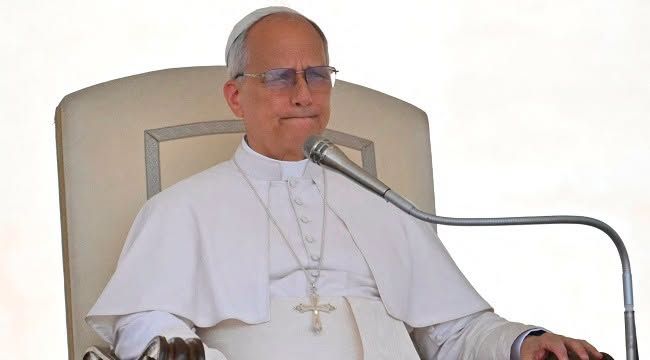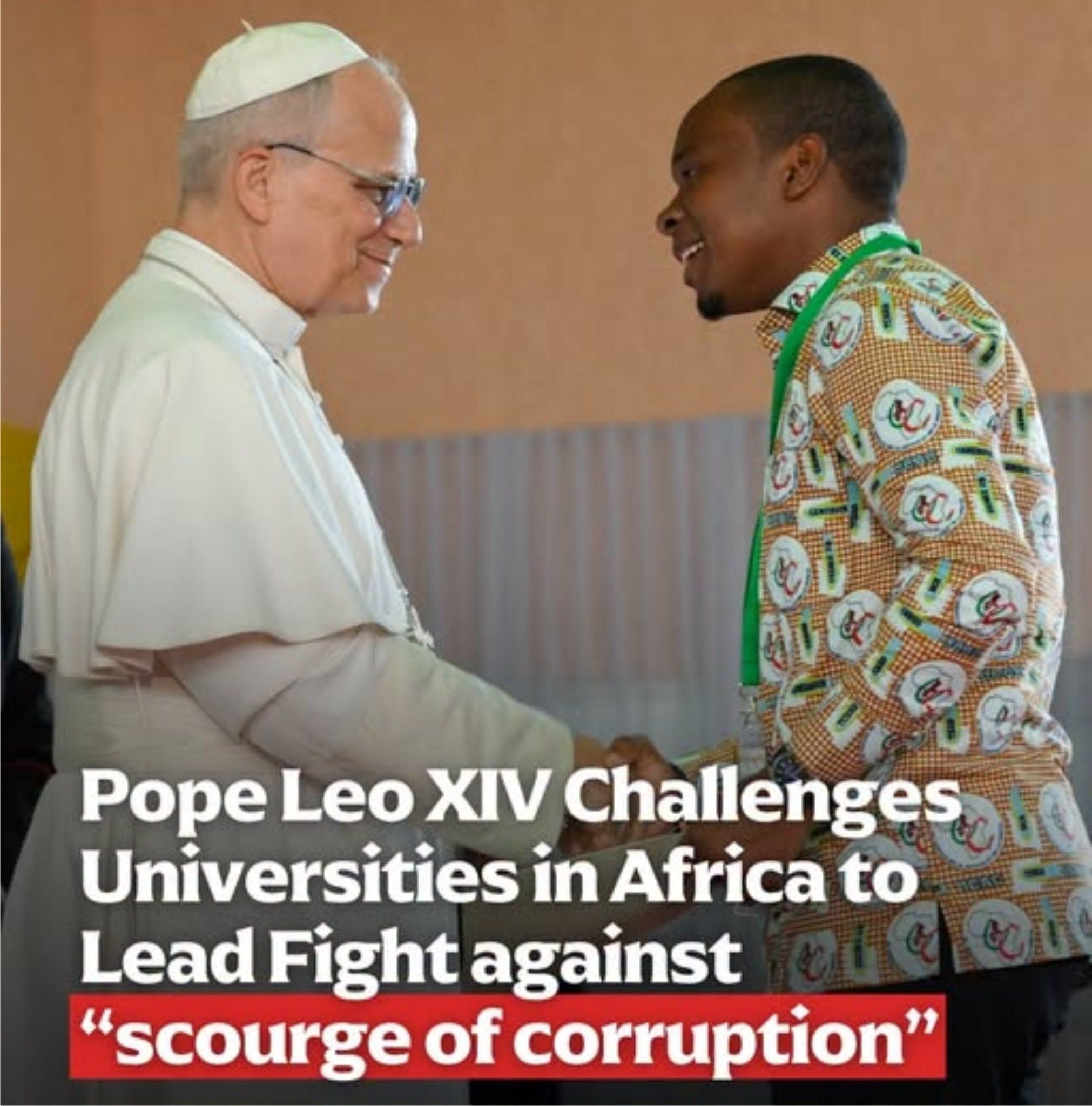
Pope Leo XIV has described corruption in Africa as a “scourge”, challenging universities on the continent to lead the fight against the vice by churning out young people who are not only equipped intellectually but whose consciences are also formed with fairness, integrity, and the spirit of service.
In his Friday, April 17 meeting with students and staff of the Catholic University of Central Africa (UCAC) in Cameroon, Pope Leo underlined the need for professors, in particular, to form citizens who place their talents at the service of the common good.
“Dear professors, your role is essential,” Pope Leo XIV said, and added, “As well as being intellectual guides, be role models whose scientific rigor and personal integrity form the consciences of your students.”
“Africa, indeed, must be freed from the scourge of corruption,” the Holy Father said in his address at the Yaoundé-based institution on the third day of his visit in the central African country.
He challenged university professors in Africa to embody the values they wish to impart, including integrity and a sense of responsibility.
Pope Leo XIV urged university scholars to have the awareness that Africa needs to rid itself from corruption.
He noted that alongside the transmission of knowledge and the development of professional competencies, UCAC seeks to contribute to the integral formation of the human person. “Spiritual and human accompaniment constitutes an essential dimension of the identity of the Catholic university,” he said.
The Holy Father also challenged students at the University to emulate “the moral rigor, selflessness and coherence of life” shown by their educators and teachers.
Pope Leo XIV expressed his joy at being at UCAC, the institution founded in 1989 by the Association of Episcopal Conferences of Central Africa.
He expressed hope that the university will continue serving as a beacon for the Church and for Africa “in its search for truth”, as well as its promotion of justice and solidarity.
In his address, the Holy Father challenged universities to foster a culture of friendship, cooperation and “interiority and reflection” as their way of confronting issues in a world he said seems to be losing its “ethical points of reference.”
“Today our proclamation of the Gospel and the Church’s doctrine are called to promote a culture of encounter, in generous and open cooperation with all the positive forces that contribute to the growth of universal human consciousness,” Pope Leo XIV said.
Be continued, “Indeed, at a time when many in the world seem to be losing their spiritual and ethical points of reference, finding themselves imprisoned in individualism, superficiality and hypocrisy, the university stands out as a privileged place of friendship, cooperation and, at the same time, of interiority and reflection.”
The Holy Father appealed to African researchers, in particular, to be open to interdisciplinary, international and intercultural perspectives, acknowledging their ability to contribute to broadening what he described as “the overly narrow horizons of a humanity.”
“Dear friends, Africa can make a fundamental contribution to broadening the overly narrow horizons of a humanity that struggles to hope,” he said, and added, “In your magnificent continent, researchers are especially called to open themselves to interdisciplinary, international and intercultural perspectives.”
“Today, moreover, there is an urgent need to think about faith within the framework of contemporary cultural contexts and present challenges, so that its beauty and credibility may emerge in diverse settings, especially in those most marked by injustice, inequality, conflict and both material and spiritual degradation,” Pope Leo said.
According to the Holy father, the greatness of a nation cannot be measured solely by the abundance of its natural resources, nor even by the material wealth of its institutions.
“No society, in fact, can flourish unless it is grounded in upright consciences, formed in the truth,” he said, and reminded professors at the Catholic university in Cameroon to form consciences that are “free and endowed with a holy restlessness.”
Pope Leo’s third day in Cameroon kicked off with Holy Mass at Japoma Stadium where he described young people in Cameroon as “the beloved children of the African continent”.
In his homily, the Holy Father urged young Cameroonians to multiply their talents with others in the Central African nation by sharing the faith as a source of inspiration.
After the Eucharistic celebration Pope Leo XIV took a private visit to Saint Paul Catholic Hospital.
Before leaving the Central African nation for Angola on Saturday, April 18, Pope Leo XIV will celebrate Holy Mass at Yaoundé-Ville Airport.