Google Wallet Launches In Nigeria As Tech Giant Targets Tap-To-Pay Growth
Although the CBN issued regulatory guidelines for contactless payments to standardise transaction limits and risk management, physical merchant infrastructure remains a hurdle.
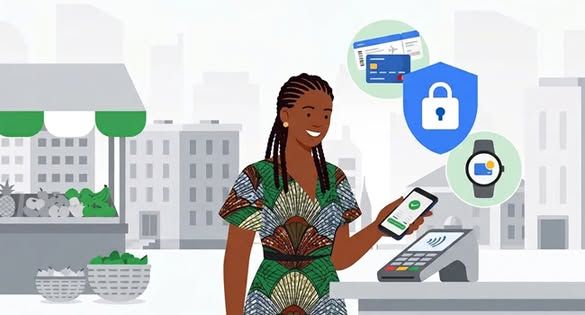
Tech giant Google has officially launched Google Wallet and Google Pay in Nigeria, introducing contactless tap-to-pay functionality for Android smartphone and Wear OS smartwatch users.
The service allows cardholders to digitise payment cards for physical point-of-sale (PoS) checkouts, web purchases, and digital storage of event tickets and flight boarding passes.
At launch, the integration is restricted to select card products issued by four commercial banks: First Bank of Nigeria, Guaranty Trust Bank (GTBank), United Bank for Africa (UBA), and Zenith Bank. The initial rollout operates primarily on Mastercard rails—spanning debit, credit, and prepaid cards—alongside select UBA Visa prepaid products.
Confirming the rollout, Google stated that the expansion aims to provide Android users with an alternative digital checkout channel:
“Google Wallet, including Google Pay, is now available in Nigeria, bringing fast, simple, and secure digital payments to Android and Wear OS users across the country. Users can add supported cards from participating financial institutions to make secure, contactless payments using ‘Tap to pay’ in stores, in apps, and online.”
Market Realities: Tap-To-Pay Versus Direct Transfers
While contactless mobile wallets are ubiquitous across developed economies in Europe and North America, Google’s arrival in Africa’s largest financial technology market faces a distinct structural landscape.
Data from the Nigeria Inter-Bank Settlement System (NIBSS) shows that electronic payment volume across the nation is overwhelmingly driven by NIBSS Instant Payments (NIP) bank transfers, USSD protocols, and physical chip-and-PIN PoS transactions. During the 2023 cash crunch and subsequent cash-lite policy pushes by the Central Bank of Nigeria (CBN), direct bank transfers and agency banking networks expanded rapidly, cemented by mobile-first fintechs such as OPay, Moniepoint, and PalmPay.
Furthermore, domestic card schemes like Interswitch’s Verve—which accounts for more than half of physical card payments across the country—and the CBN-backed AfriGO national card scheme are currently excluded from Google Wallet’s local support list, as are cards issued by non-bank fintech platforms.
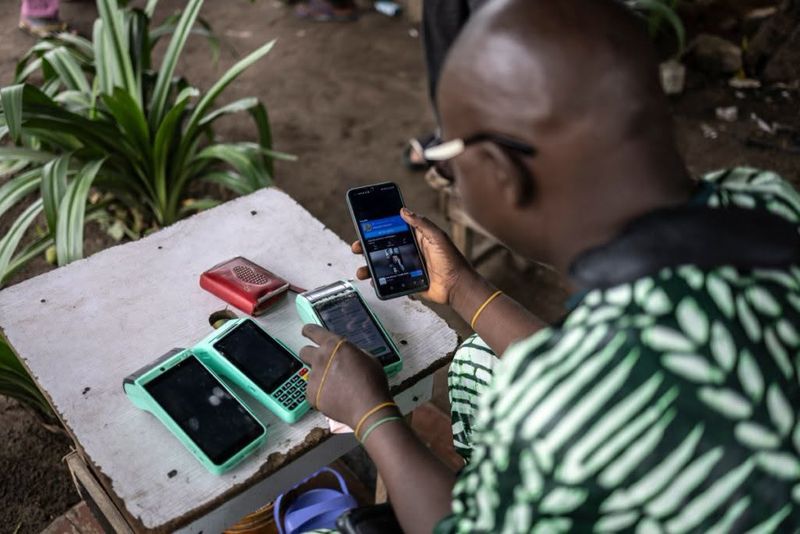
(FILES) A worker works on his wireless cash machine in Ikoyi island in Lagos on September 16, 2024. – (Photo by Olympia DE MAISMONT / AFP)
Although the CBN issued regulatory guidelines for contactless payments to standardise transaction limits and risk management, physical merchant hardware remains a hurdle.
To execute an in-store tap-to-pay transaction, an Android user requires a Near Field Communication (NFC)-enabled device, while the merchant must operate a PoS terminal equipped with active NFC contactless readers. Industry estimates indicate that NFC-enabled PoS terminals represent a tiny fraction of active merchant hardware in Nigerian markets.
However, web and in-app integration face fewer friction points. Local payment processors, including Paystack and Interswitch, have integrated Google Pay support into their online payment gateways, enabling eligible Nigerian cardholders to complete digital e-commerce checkouts without manually entering 16-digit card numbers.

(FILES) A man counts Nigerian Naira currency as a customer exchanges money in Ikoyi island in Lagos on September 16, 2024. – (Photo by Olympia DE MAISMONT / AFP)
Addressing consumer concerns regarding mobile device security, Google noted that transaction data is protected through payment tokenisation. Under this framework, primary account numbers (PAN) are replaced with dynamic, encrypted device tokens during merchant transmission.
“Built with multiple layers of security and industry-standard encryption, Google Pay protects financial data with every transaction,” the company added, noting that misplaced devices can be remotely locked or erased using Android’s ‘Find My Device’ feature.