They are due to loop around the Moon early next week -- a feat not accomplished in more than 50 years.
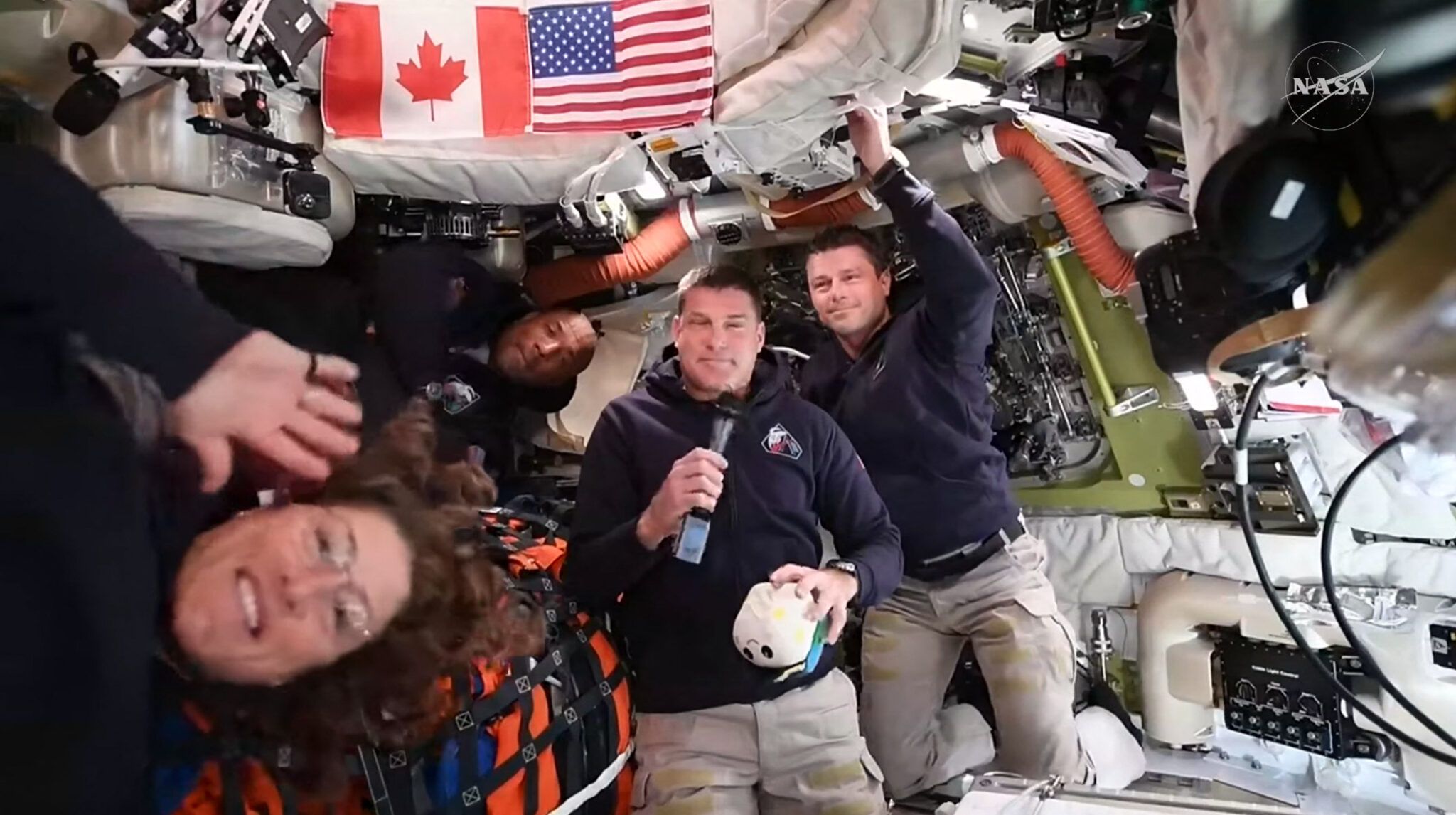
This screen grab from NASA’s feed released on April 3, 2026, shows the four Artemis II crew members (L-R) Canadian Space Agency (CSA) astronaut Jeremy Hansen, Artemis II mission specialist, NASA astronauts Reid Wiseman, Artemis II commander, Christina Koch, Artemis II mission specialist and Victor Glover, Artemis II pilot as they head to orbit the Moon for the first time in more than half a century. Photo by HANDOUT / NASA TV / AFP
The Artemis 2 astronauts have passed the halfway point between Earth and the Moon on Saturday as they sped toward a planned lunar flyby, with NASA releasing initial images of Earth taken from inside the Orion spacecraft.
Astronaut Christina Koch said the crew had a collective “expression of joy” upon being told of the milestone, which was hit around two days, five hours, and 24 minutes after the spacecraft blasted off from the Kennedy Space Center in Florida.
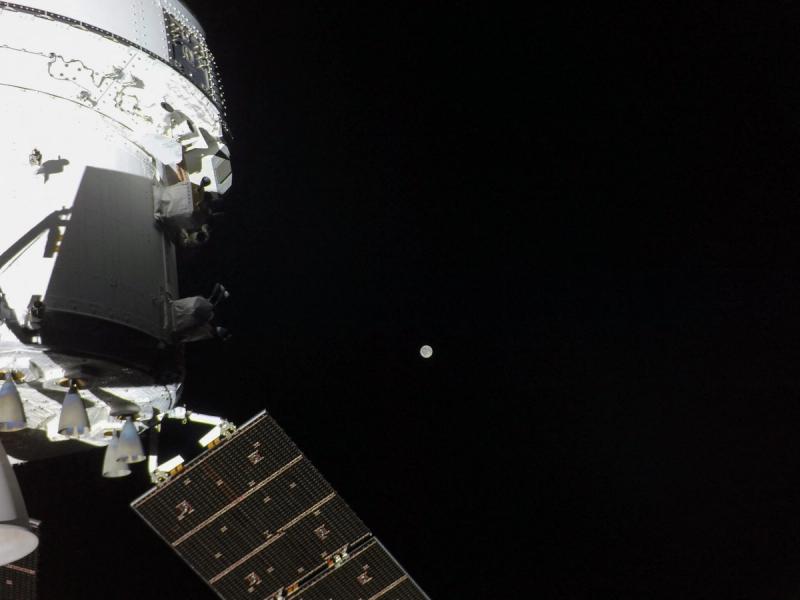
“We can see the Moon out of the docking hatch right now, it is a beautiful sight,” Koch said around 11 pm (0400 GMT) Friday, according to the space agency’s official live broadcast.
This handout picture provided by NASA shows the Orion spacecraft with the Moon in the distance, as captured by a camera on the tip of one of its solar array wings, on April 3, 2026. (Photo by NASA / AFP)
NASA’s online dashboard showed early Saturday that the Orion spacecraft carrying the astronauts was more than 229,000 kilometres (142,000 miles) from Earth.
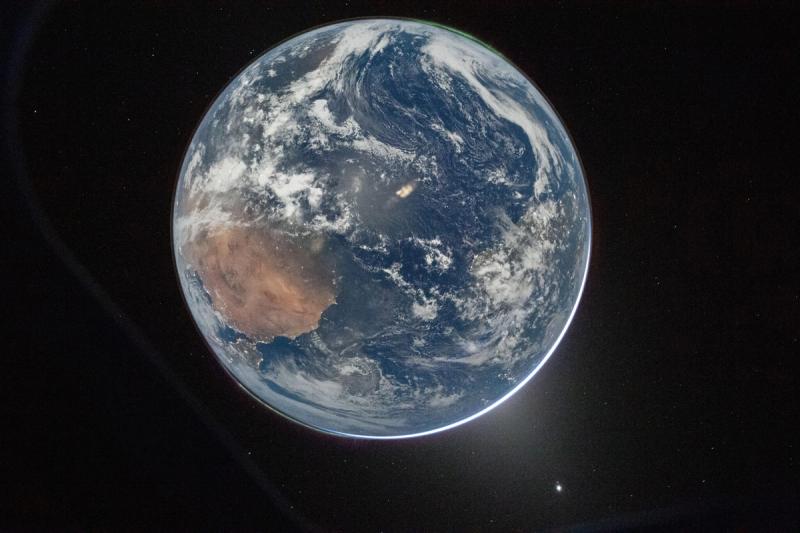
The space agency earlier released images from Orion that included a full portrait of Earth, featuring its deep blue oceans and billowing clouds.
After a flurry of high-stakes activity, including a dramatic blast-off and an engine firing that catapulted them on their historic trajectory to circle the Moon, the four astronauts aboard were able to catch their breath, even as they continued to perform a variety of equipment checks and tests.
“There has been a tremendous amount of disbelief for me, it’s just so extraordinary,” said Canadian Jeremy Hansen during a Q&A session with press late Thursday.
“I really like it up here,” said Hansen, on his first-ever journey to space. “The views are extraordinary.”
“It’s really fun to be floating around” in zero gravity, he added. “It just makes me feel like a little kid.”
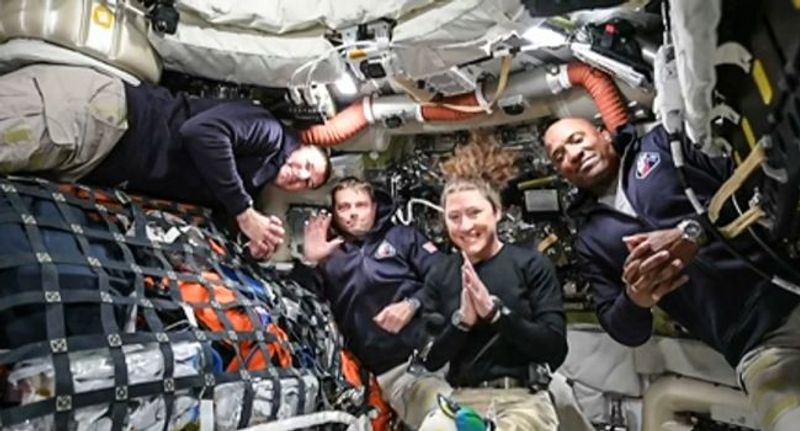
This screengrab from a NASA live broadcast video shows (L-R) NASA astronaut and Artemis II Mission Specialist Christina Koch, NASA astronaut and Artemis II pilot Victor Glover, Canadian Space Agency astronaut Artemis II Mission Specialist Jeremy Hansen and NASA astronaut and Artemis II Commander Reid Wiseman during a press call as they travel to the Moon in the Orion spacecraft, on April 3, 2026. (Photo by NASA / AFP)
Hansen is on the crew with Americans Koch, Victor Glover, and Reid Wiseman.
They are due to loop around the Moon early next week — a feat not accomplished in more than 50 years.
NASA official Lakiesha Hawkins praised the photographs taken by commander Wiseman, calling them “amazing” during a briefing Friday.
“We continue to learn all about our spacecraft as we operate it in deep space with crew for the first time,” Hawkins said.
“It’s important to remind ourselves of that as we learn a little bit more day by day.”
‘Great spirits’
This handout picture provided by NASA shows a view of Earth taken by NASA astronaut and Artemis II commander Reid Wiseman from one of the Orion spacecraft’s four main windows after completing the translunar injection burn on April 2, 2026. (Photo by Reid Wiseman/NASA / NASA / AFP)
Friday’s to-do list includes a CPR demonstration and medical kit checks, the US space agency said, as well as preparation for the scientific observations they’ll need to document when they are closest to the Moon on day six of their journey.
NASA officials reported Friday that all systems were performing well, and that the astronauts were in “great spirits” and had spoken to their families.
The next major milestone of the approximately 10-day journey is expected overnight Sunday into Monday, at which point the astronauts will enter the “lunar sphere of influence” — when the Moon’s gravity will have stronger pull on the spacecraft than Earth’s.
If all proceeds smoothly, as Orion whips around the Moon the astronauts could set a record by venturing farther from Earth than any human before.
“There is nothing normal about this,” said mission commander Wiseman late Thursday.
“Sending four humans 250,000 miles away is a Herculean effort, and we are now just realizing the gravity of that.”
The Artemis 2 mission is part of a longer-term plan to repeatedly return to the Moon, with the goal of establishing a permanent lunar base that will offer a platform for further exploration.